How long does Botox last in forehead?
Botox injections are taken by many people to flatten forehead lines and keep a youthful expression. One of the most common questions is: how long does Botox last in the forehead? The information on the time will allow you to schedule treatments and establish expectations of the forehead wrinkle reduction and general facial rejuvenation.
In comparison with a surgical procedure, Botox injections in Islamabad have a short-term but reliable effect. With good timing and treatment, you will be able to have a few months of smooth skin before you have to go through another session.
What Makes Forehead Botox Different?
- The forehead muscles are active during the day.
- Results depend on muscle strength and facial movement
- Balanced expressions should be appropriately placed.
- The time may take different periods depending on the individual.
Understand Botox for the Forehead
Clostridium Botulinum is a bacterium, the derivative of which is called Botox and is used to reduce wrinkles and lines on the face by temporarily paralysing the muscles on the face by blocking the repetitive actions of the face muscles. On the forehead, Botox has been shown to flatten horizontal lines and raise the eyebrows to produce a fresher, younger look.
What to Expect Before and After Botox?
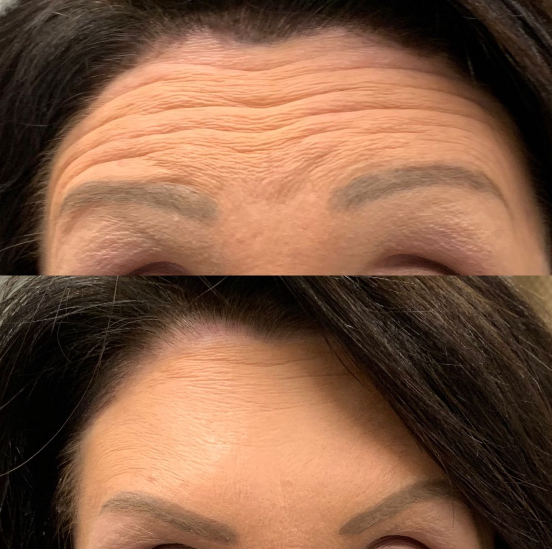
Before diving into the treatment process, it’s essential to have realistic expectations about Botox for the forehead. Although each outcome might be different, as a patient, you are normally able to observe the progressive appearance of your forehead a few days to a week after the treatment. The lines and wrinkles become less visible, and the forehead is smoother and younger.
Important Injection Points for Forehead Botox
Effective Botox treatment on the forehead demands accurate modes of injection on particular muscles. The major points of injections will be:
Frontalis Muscle
This is a muscle that raises the eyebrows and makes horizontal wrinkles on the forehead. By placing Botox into specific locations of the frontalis muscle, it is possible to even these lines and give the eyebrows a slight lift.
Glabellar Complex
One of the most frequent Botox injection points is also referred to as the 11 lines or frown lines, which is an area between the eyebrows. Botox can be used to relax the muscles in this region and thereby soften the vertical lines, making the person appear more relaxed. It is categorized as an individual zone to the forehead, which is known as the glabellar lines, but is also addressed as the forehead lines.
Temporalis Muscle
Not on the forehead, but by injecting Botox into the temporalis muscle, forehead treatments may also be done in a way that the temples are tensioned and wrinkled.
When Do You Start to See Results and Their Timeline?
Botox doesn’t work instantly. The treatment slowly loosens muscle signals, but over time, the skin becomes smooth. Here is a rough schedule of the action to look forward to:
- 3-5 days following injection: early softening begins.
- 10-14 days: maximum effect and the majority of the smoothing is apparent.
- Weeks 8-12: normal look persists.
- At around 3-4 months, the muscle activity has returned, and the lines are slowly restored.
Other patients start experiencing slight movement recovery earlier than 3 months, whereas others require more maintenance with follow-ups.
See also: Benefits of Digital Health Technology
Why People Choose Botox for the Forehead?
- It eases tight muscles, which cause expression lines.
- When properly done, results seem natural but smooth.
- Helps prevent deep lines from being permanent.
- Requires no surgery or long recovery time
Normal Botox Duration Per Facial Area
| Treatment Area | Average Lasting Time | Notes |
| Forehead | 3–4 months | Most standard range |
| Frown lines (between brows) | 3–4 months | Similar to the forehead |
| Crow’s feet | 2.5–4 months | Muscles here move often |
| Bunny lines (nose wrinkles) | 2–3 months | Small, high-activity area |
| Lip area | 2–4 months | High movement zone |
Why Does Botox Not Work Forever?
The work of Botox is the blockage of nerve impulses to the muscles that produce dynamic wrinkles, wrinkles produced by making a face expression like lifting eyebrows or squinting. With sessions, the body processes the botulinum toxin injected, and the nerve signals start returning to a normal state. The resumption of muscle activity results in the appearance of forehead lines, as well as the loss of smoothness of the skin. This is the normal course of events rather than an indicator of a failure; it is merely the way temporary treatments work.
Risks of Forehead Botox Gone Wrong
Although it is effective when done in the right way, Botox on the forehead has its side effects, especially when in the hands of an incompetent or untrained expert. Forehead Botox may cause complications that may not go away and include:
- Drooping eyebrows or eyelids (ptosis)
- Inequal or asymmetrical outcomes.
- Over-relaxation of the muscles, which results in a frozen or unnatural appearance.
- Headaches or discomfort
When to Book Your Next Botox Appointment?
Most patients normally come back after 3 to 4 months to have Botox touch-ups because of the smooth and youthful forehead they have. Regular appointments will avoid the recurrence of deep-set lines and will leave your look constantly refreshed, too. Enfield Royal Clinic Islamabad develops a special plan on a personal level for each patient so that the results become effective and naturally beautiful.