Dry Ice vs Gel Ice: Which Is Better for Cold Chain Transportation?

Maintaining the right temperature during transportation is one of the biggest challenges for businesses dealing with frozen food, ice cream, pharmaceuticals, and laboratory samples. Even a small temperature fluctuation can lead to spoilage, financial loss, and customer complaints. This is why choosing the right cooling method is critical for an effective cold chain transportation system.
Two of the most commonly used cooling solutions today are dry ice and gel ice packs. While both serve the purpose of temperature control, they work very differently. In this article, we will compare dry ice vs gel ice and help you understand which option is better for your transportation needs.
What Is Dry Ice?
Dry ice is the solid form of carbon dioxide (CO₂). Unlike regular ice, it does not melt into water. Instead, it sublimates directly from solid to gas, making it an excellent cooling agent for long-distance and sensitive shipments.
With a temperature of approximately -78.5°C, dry ice is widely used in frozen food delivery, pharmaceutical transport, and laboratory sample shipping. Many professional suppliers provide dry ice in different sizes to meet industrial and commercial requirements.
Businesses looking for reliable and long-lasting cooling solutions often rely on trusted providers like Pak Dry Ice, which supplies high-quality dry ice for multiple industries.
What Is Gel Ice?
Gel ice packs are sealed plastic packs filled with a cooling gel. They are commonly used for short-distance transportation and products that require cooling but not deep freezing.
Gel ice packs usually maintain temperatures between 0°C and -20°C, depending on the product and insulation. Because they are reusable and easy to handle, gel ice packs are popular among small businesses and local delivery services.
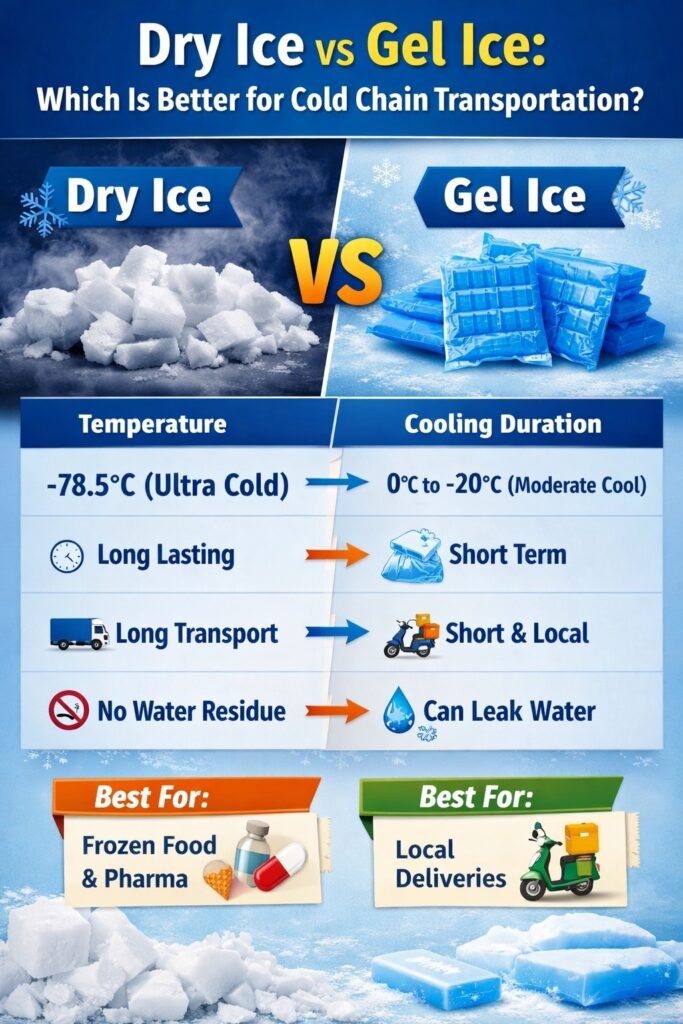
Key Differences Between Dry Ice and Gel Ice
Temperature Performance
- Dry Ice: Ultra-low temperature, ideal for frozen and highly sensitive items
- Gel Ice: Moderate cooling, suitable for chilled products
Cooling Duration
- Dry Ice: Long-lasting cooling, even in hot climates
- Gel Ice: Short-term cooling, melts over time
Transportation Distance
- Dry Ice: Best for long-distance and overnight shipments
- Gel Ice: Ideal for local and short routes
Moisture Control
- Dry Ice: No water residue
- Gel Ice: May leak if packaging is damaged
Why Dry Ice Is Preferred for Cold Chain Transportation
For businesses involved in ice cream transport, frozen meat delivery, vaccines, and medical samples, dry ice offers several advantages:
Reliable Deep Freezing
Dry ice ensures products remain frozen throughout the journey, even during long transit times.
Ideal for Professional Logistics
Cold chain logistics require consistency. Dry ice provides stable temperature control, making it suitable for commercial and export shipments.
Suitable for Multiple Industries
From food to healthcare, dry ice is a versatile solution used across various sectors. Many companies choose specialized dry ice services to ensure safe handling and proper packaging.
When Gel Ice Is the Better Option
Despite the advantages of dry ice, gel ice packs also have practical uses:
- Short-distance food deliveries
- Medicines that require cooling but not freezing
- Budget-friendly and reusable solutions
- Easy handling with minimal safety requirements
For small-scale operations, gel ice packs can be a cost-effective alternative.
Safety Considerations
Dry Ice Safety
Dry ice must be handled carefully using gloves and proper ventilation, as it releases carbon dioxide gas. Correct packaging and labeling are essential during transportation.
Gel Ice Safety
Gel ice packs are safer to handle and do not require special ventilation, making them suitable for non-industrial use.
See also: Benefits of Educational Technology
Conclusion
Choosing the right cooling solution plays a vital role in successful cold chain transportation. While gel ice packs are suitable for short-distance and low-risk deliveries, dry ice remains the preferred choice for businesses that require long-lasting, ultra-low temperature control. Its reliability, efficiency, and suitability for sensitive products make it an essential solution for professional logistics, food transport, and medical applications. By understanding your product requirements and transportation distance, you can select the most effective cooling method and protect your goods from damage and spoilage.